
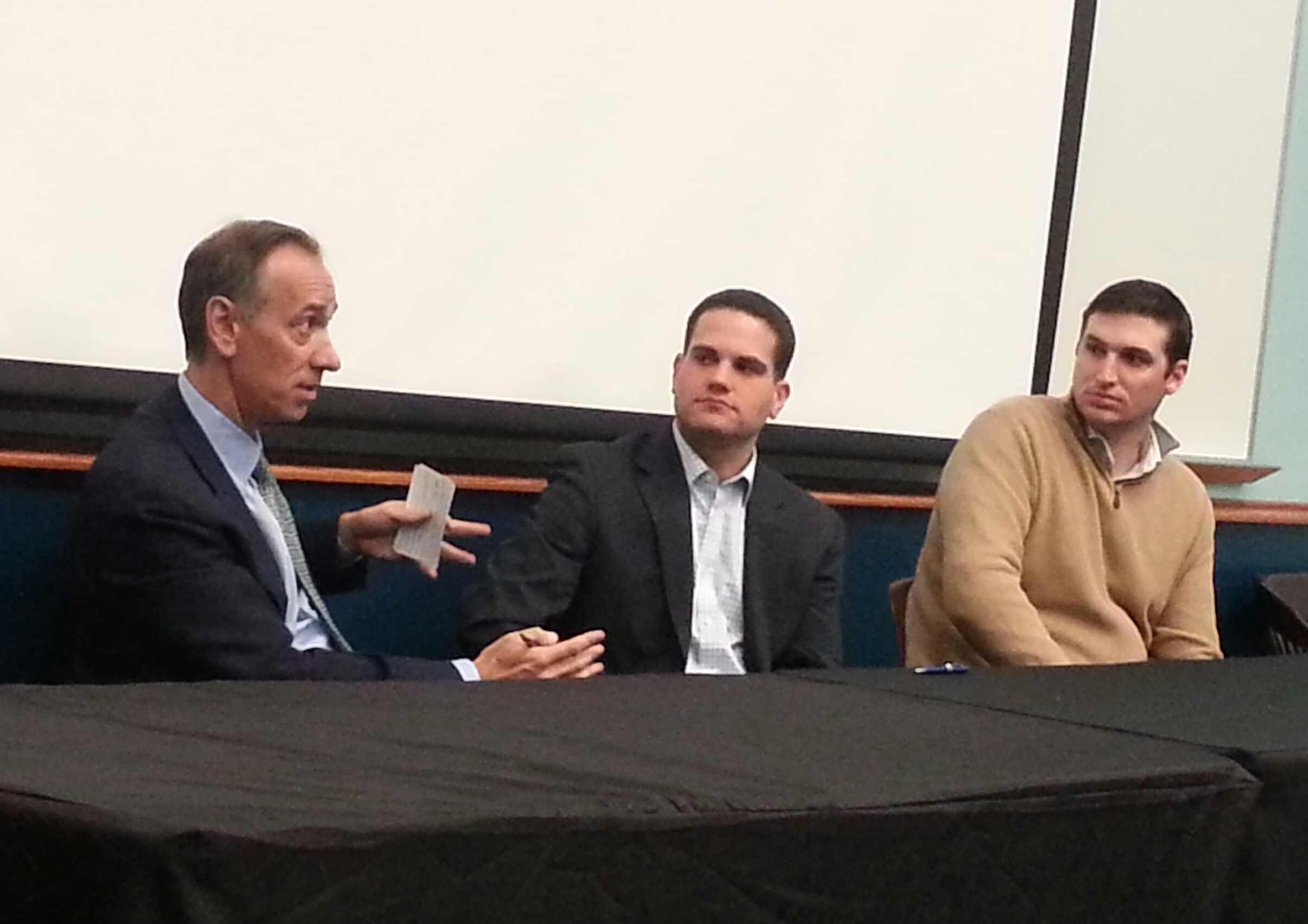
Towson students packed into Van Bokkelen Hall on March 4 for a panel discussion on sports journalism.
As part of this year’s #TUjday, Towson welcomed panelists Greg Amante, Ryan Sharrow, and Tyler Sigmon. WBAL TV I-team lead investigative reporter Jayne Miller had planned on joining the panel, but was unable to do so after she was called away by breaking news.
The panel, moderated by Towson professor Megan Gilbert, covered a wide array of topics including proper source location/evaluation, investigative reporting, media partnerships, and journalism ethics.
Amante, who is the feature producer for ESPN’s “Outside the Lines,” explained that media partnerships can sometimes make investigative journalism difficult, but reporters must hold all people accountable for their actions no matter the professional or personal relationship.
“You just make sure when you’re doing investigative journalism—whether of a broadcast partner or a non-broadcast partner—make sure you’ve got all the facts,” Amante said. “Make sure that your sources are solid….Make sure that you have things like documents, things that are hard and, you know, tangible evidence.”
Sigmon, a TU assistant professor of kinesiology, spoke about the power that the audience has on the media’s product.
“If we’re not happy with what we’re seeing on ESPN or these other places, then that’s not ESPN’s fault; it’s your fault,” Sigmon said.
He went on to compare the accountability of journalists to that of politicians as both are governed by their viewers/constituents.
“Every time you turn on the television, that’s as if you’re stepping into a voting booth,” Sigmon said. “…Just as if we had a politician who wasn’t doing things on the up-and-up, you’d vote him out of office. Well, the same thing can be said of your viewing habits and your consumption habits.”
Sharrow, Managing Editor of the Baltimore Business Journal, spoke about the importance of following up on stories and delving deeper than the surface level.
“I think you’ll tend to find too that on the bigger stories, you’ll find more people come to you with more information as you go for a really good follow-up,” Sharrow said. “…There’s probably more to the story if you sort of peel the layers of the onion.”
The panelists also discussed the growing importance that the media is placing on immediacy of information and how this trend impacts the accuracy of reporters’ stories.
“In our race to be first we’re probably getting a lot wrong here to make sure we’re getting our names on things,” Sigmon said. “I think we’re at a crossroads here. We kind of have to determine what we’re going to value: those who get it first or those who get it right.”
The panel discussion was met with a positive reaction from the audience. Many attendees stayed after the event to talk to the panelists one-on-one.
Andrea Rizkallah, a mass communication major and senior, attended the event as part of her class. Rizkallah, who said she had little prior knowledge of sports journalism before the event, explained that the panelists gave her a new perspective.
“I did learn about where journalism is going, what people that have been in journalism for a long time think about it now which is a very interesting perspective because those people have gone through all of the changes in the field versus us—we’re coming into all of the changes,” Rizkallah said.
Sophomore student Dante Barboy, a mass communication and political science major, expressed interest in the panelists’ discussion of sourcing and ethics.
“They talked a lot about where to get your sources, to be very loyal to your beliefs, and to stick behind people you get sources from,” Barboy said. “And also they talked about their own experiences in the journalism industry, so I thought it was very valuable.”
The event provided a well-rounded addition to regular classroom lessons, according to Rizkallah.
“I think they answered the questions really well and I think they understood the audience that was here,” Rizkallah said. “And I think that events like this are a really good compliment to classes and to the education that we have here.”
 Marcus Dieterle