
At the corner of Goucher College’s library, The Athenaeum, sits the apiary’s pair of wooden beehives: one blue, one yellow, and two very different stories.
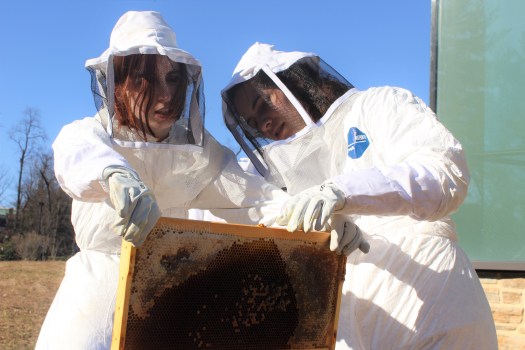
Goucher students Olivia Baud and Fiona Rutgers, along with their club partner and faculty member, Marjorie Pryse, suited up on March 8 before inspecting the hives.
Baud, a sophomore at Goucher, said she and her co-president, Virginia Turpin, founded the Beekeeping Club during the fall of Baud’s freshman year in 2015. The two were working together on a biology project in the naturalized meadow in front of the Athenaeum when Turpin noticed all of the bees flying around the area. With a burst of inspiration, the pair decided to create a beekeeping club.
Turpin is currently studying abroad, but Baud said the club is still alive with membership ranging from seven to 30 members throughout the year.
After Pryse and her wife moved to a home where beekeeping was not allowed, Pryse decided to put her beekeeping resources to good use by joining the club as a faculty member.

On a mild but windy March afternoon, Baud and Rutgers each stepped into their bright white, one-piece, beekeeping suits. They wrapped rubber bands around their ankles to keep bees from flying up their pant legs, and slipped on gloves to protect their hands.
Next came the veils: white masks with metal mesh all around, resembling fencing masks but a lot roomier. They then connected the veils to the suits by looping a string through a tab on the veil and front of the suit, wrapping the string around their torsos a couple times, and tying it just loosely enough for a quick pull-and-escape in case a bee managed to enter the suit.
The beekeepers began inspecting the blue hive by removing the lid and lifting each frame one-by-one out of the top box. They examined the frames for bees and honey before scraping off the crystallized residue and stacking the frames off to the side.
Pryse showed how each frame was preset with a honeycomb template. The bees create their own hexagonal honeycombs to house their larvae and store honey and pollen.
Once the top box was empty, the beekeepers repeated the process with the lower box called the brood section where the queen lays her eggs.
As the beekeepers removed the final frames from the brood section, things were looking grim. The beekeeping trio briefly mourned the small pile of dead bees lying at the bottom of the box before reassembling the hive.
During the winter, the worker bees gather around the queen to warm her up to 80 degrees Fahrenheit.
Pryse suggested that this hive might not have had enough bees to successfully cluster around the queen, causing her and the rest of the colony to die.
If the bees congregating on the outside of the yellow, second hive were any indicator, things were looking hopeful.
Baud and Rutgers first lit the smoker which resembled a tall tea kettle surrounded by a protective wire grid and attached to a bellows. They used pine needles as kindling because the fumes are the least toxic for the bees. Not to mention they smell nice when they’re burned.
Baud filtered smoke in through the top and sides of the hive to keep the bees inside at bay.
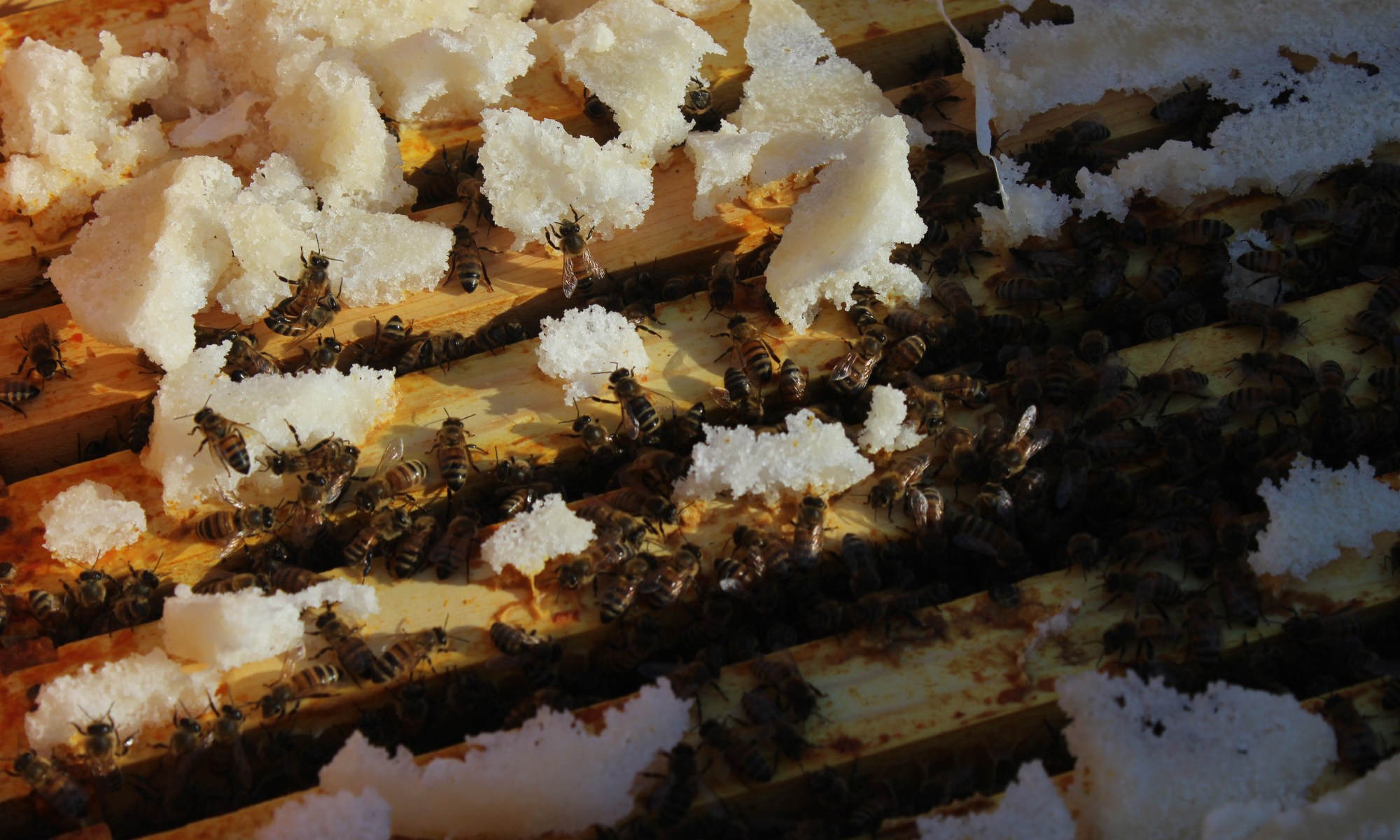
Inside the hive, the bees could be seen crawling around pieces of fondant — essentially sugar candy — that had been left over the winter as food for the bees. Pryse added more fondant to the top box before closing the lid.
Baud said that beekeeping in urban and suburban areas is actually more effective than in rural environments.
“Bees are actually more successful in urban and suburban environments than out in the countryside currently because out in the countryside is where they’re going to be more exposed to pesticides ironically, whereas in a suburban/urban environment it’s less likely,” she said. “And also, there’s more of a wide variety of flowers in a suburban and urban environments just because people plant gardens. And nowadays with monoculture type agricultural endeavors there’s less flowered spaces for bees.”
Towson area beekeper Luke Goembel decided to start beekeeping in the summer of 2008 after taking a mead-making class with his father-in-law. Goembel, who has a Ph.D. in chemistry, learned that beekeeping is a good way to produce a ready store of honey with which to make mead.
After researching beekeeping, Goembel went out to his local home improvement store and bought planks of wood which he used to construct his hives.
Goembel said the most common type of hive, which he uses as well, is the Langstroth hive. The Langstroth, named after 19th century beekeeper Reverend Lorenzo Lorraine Langstroth, contains removable frames that fit inside stackable boxes.
Goembel estimates that his hives’ rectangular boxes are about 18 inches by 16 inches around and about five inches tall. Boxes can be stacked on top of each other to make a larger hive as bees require more space to produce honey.

During the winter, most hives consist of only the brood section. As the weather warms up and the bees begin “spring flow,” a period from about April to June in which flowers bloom and the bees seek nectar and pollen. At that time, beekeepers add boxes on top of the brood section, sometimes doubling or even tripling the size of the hive, Goembel said.
He explained that to make a queen, the worker bees take an egg and place it in a peanut-shaped cell made of wax. The workers feed the egg royal jelly — a honey bee secretion that provides nutrients to larvae and adult queens — thus producing a queen. After a little less than a month from placing the egg in the cell, the queen emerges.
Goembel said queen bees look similar to workers, however, a queen bee’s abdomen is 50 percent longer than a worker’s abdomen, bright yellow, and “glows like the sun.”
When the worker bees create multiple queens, Goembel said the queens fight to the death gladiator-style until only one remains and reigns supreme.
“It’s survival of the fittest,” he said.
During breeding season, Goembel explained that the queen will leave the hive on what is called a mating flight in which she flies to a drone congregation to be fertilized by a number of drones, or male bees.After fertilization, the queen flies back to her hive and starts laying eggs.
After mating, the drone de-couples from the queen which causes their mating apparatus to be ripped out and the drone dies. The worker bees kick out any drones that remain in the hive because those drones have been unable fulfill their sole purpose of fertilizing the queen and would merely use up precious honey resources over winter without contributing anything to the hive.
According to Goembel, it is imperative for the queen to mate immediately because she must be fertilized within a few week of emerging from her cell.
While most beekeepers yield little to no honey in their first year, Goembel said he was able to harvest 30 pounds of honey by the end of his first summer. He has averaged an annual total of about 154 pounds of honey per year over the eight years that he has been beekeeping.
Goembel’s best year for beekeeping was 2011 when he harvested 340 lbs of honey; his worst year was 2015 in which his foragers suffered from a mosquito spraying and he harvested 60 lbs of honey.
When he was first beginning beekeeping in the spring of 2009, Goembel ordered two packages of bees — each containing one queen and three pounds of workers for $70 — and hasn’t bought any more bees since. In fact, he’s been able to expand his hives from the two he started with to the four that he has kept since 2010.

Whatever honey that Goembel and his family do not use themselves, Goembel usually sells to his neighbors, but he said he’s not really concerned with making a profit; beekeeping is more of a hobby for him.
Goembel sells one quart of honey for $20 which he said is far cheaper than the going rate.
The honey that Goembel sells is raw, meaning it hasn’t been heated, pasteurized or filtered. However, Goembel said honey’s high sugar content causes it to have antibacterial and antiviral properties, making it perfectly safe to eat raw.
Goembel attributes his beekeeping success, at least in part, to the fact that he lives in a suburban area. Rural beekeepers, he said, are more susceptible to pesticides due to the fact that farm areas use chemicals that are harmful to bees.
“There’s overwhelming evidence that points to pesticides as being at least partially responsible for the decline in the pollinator population,” he said.
Goembel also kills or captures a variety of creatures that might otherwise harm his bees. First, he created oil moats around his hives to stop ants from trespassing; second, he configured traps for capturing small hive beetles; third, he uses folic acid drips and thymolated sugar syrup to reduce the prevalence of varroa mites.
Goembel explained that folic acid is naturally found in vegetables like broccoli as well as in the bees’ own honey. He drips the folic acid onto the bees, so that the mites have trouble sticking to the bees. He also puts thyme oil in the bees’ sugar syrup. Bees tolerate the thyme oil, but the varroa mites can’t stand the stuff.
The only major issues that Goembel has had were with mosquito extermination companies spraying insecticides around his neighborhood in the spring of 2015. That year, Goembel’s hives suffered a tremendous loss when practically all of his foragers, a type of worker bee that leaves the hive in search of nectar and pollen, died.
“My whole neighborhood came to my rescue when my foragers were killed off…. The Mosquito Joe and Mosquito Squad signs were all over the neighborhood and those guys were running around,” Goembel said. “It seemed like every day I’d see the trucks and the guys running out and spraying. When my neighbors found out that my bees were probably killed by those mosquito spraying services, the next spring, instead of seeing dozens of signs, I saw maybe one or two yard signs for these sprayers.”
Goembel said he hasn’t had any issues with melissophobic (that’s “fear of bees,” kids) neighbors.
“My neighbors never complain about my bees,” Goembel said. “As a matter of fact, neighbors come up to me and want to buy my honey and they compliment me.”
He recommended that any beginner beekeeper should join a beekeeping association, such as the Central Maryland Beekeeping Association where he is a member.
He also suggests that anyone beekeeping in an urban or suburban environment should give a free jar of honey to each of their adjacent neighbors once per year as a symbol of good faith.
From bees to beekeepers to even neighborhood bee-admirers, the sense of community is unbeelievable.
“It’s really interesting to see how [bees] work together as a collective organism…. All this incredible communication and collaboration that you’d never suspect is part of a colony,” Baud said.
 Marcus Dieterle